The method, diagnosis and evidence behind each subject — reading, writing and maths — set out in full.
I am expert at developing a child's reading — from their first recognising words on the page, to becoming a fluent, intelligent reader, capable of articulating a real, deep understanding of what they've read.
It boils down to two skills: decoding, the process of recognising the words on the page; and comprehension, understanding and interpreting what they mean. Here's how I build both.
Decoding is turning print into sounds, and sounds into words. Children learn to do this using phonics, a term from the Greek for 'sound', which reveals to a child how a language's smallest units of sound (its phonemic code) are spelled (its alphabetic code).
Take the word 'cat'. To read it, a child needs to know that the letter c makes a 'kuh' sound, the letter a makes an 'a' sound, and the letter t makes a 'tuh' sound.
Breaking the word down into those three sounds is called segmenting. Joining them back together, with no gaps between them, is called blending.
Do both, and the word has been decoded — in other words, read.
That's the theory. Here's how I build it.
I am trained in Sounds-Write, a comprehensive phonics programme for teaching children to decode. It covers every sound in the English language and all the different ways each one can be written, so a child is never caught out by a spelling pattern their lessons haven't covered yet.
I was Phonics Lead at my school, teaching phonics every day since 2018, including to older children who were still struggling to read fluently. I once rebuilt a whole class's phonics from scratch after Covid lockdown left them behind.
Phonics Screening Check pass rate — my rebuilt cohort's delayed check vs. the last pre-pandemic national average (2019) and the first official check held after the pandemic (2022).
Coming from the Latin comprehendere, 'to seize' or 'grasp hold of', comprehension is understanding what a text actually means — not just being able to read the words aloud. Indeed, it takes 'grasping' the text as a whole, not just the words one at a time.
I break comprehension down into distinct skills: retrieving information, summarising, predicting, inferring, understanding themes, and recognising authorial intent. Each skill is diagnosable and teachable on its own.
In practice, I give children a wide range of high-quality texts — fiction, non-fiction, poetry, picture books — and help them start spotting the connections: how one text echoes another, how what they're reading links to the wider world. Over time, that builds a web of general knowledge they can draw on in whatever they read next.
Oracy is important here too. I teach children to articulate their responses in clear, grammatically secure structures, building toward real rhetorical skill. At the deeper end of comprehension, that means they can not just hold an interpretation, but argue for it. I have a first-class degree in English, where close reading and arguing for one interpretation over another was the daily discipline — the same skill I now teach.
My results bear this out. The pupils I taught arrived in Year 6 below the expected standard; by their SATs, the percentage reading at the expected level had risen significantly, including children learning English as a second language, from disadvantaged backgrounds, and with additional learning needs.
With reluctant readers, the first job is diagnosis. If a child is making a lot of errors, the problem is accuracy, and they need more phonics teaching. If they're accurate but painfully slow, word by word, the problem is fluency instead — the overlooked half of decoding — and that needs a different kind of practice altogether.
Realistically, most older reluctant readers I meet fall into this second category. I build fluency using methods backed by Timothy Rasinski's research into repeated and performance reading: reading the same short passage several times until it runs smoothly, and reading aloud as a kind of performance that pushes a child toward real expression rather than flat, mechanical reading.
As accuracy and prosody both improve, so does confidence. Reading stops feeling like hard work.
"Every child has that one teacher they remember; we think you will be that teacher for our son."
That's the theory. In practice, I taught a dyslexic boy who had all but given up on reading as something he could enjoy. Through consistent, structured fluency work, he started to love reading. His parents told me, 'Every child has that one teacher they remember; we think you will be that teacher for our son.'
If reading is where your child needs support, I'd be glad to talk through what's holding them back.
Arrange a consultationFew things in teaching satisfy me more than watching a child's writing turn from their earliest marks into prose they're proud of.
To write successfully, a child must develop three key skills: transcription, the act of marking words on the page; composition, deciding what their writing says; and grammar, punctuation and spelling, the rules that make sure it's said correctly. Here's how I build all three.
Put simply, transcription is a child's handwriting. It's vital because, if it isn't automatic, it eats the concentration a child needs to compose their sentence — so what ends up on the page falls short of what they're actually capable of thinking.
Poor handwriting brings other problems too: it's slower, so a child gets less down in the time they're given; it's tiring, so children start avoiding writing altogether; and it's often illegible, hiding spelling, grammar and ideas that are actually far ahead of what the page shows.
So how do we get it right?
I teach handwriting as a deliberately taught skill, not an afterthought — starting with perfect posture, perfect page and perfect pencil grip, then building outward.
Letters are taught in sets grouped by the movement used to form them, rather than alphabetically, so a child learns one shape and reuses it across several letters. Joins are taught the same way — grouped by the movement of the join and where the next letter starts.
Letters grouped by the movement used to form them — the same letter sets I teach a child to practise, one shape at a time.
That's the theory. Here's what it looks like in practice.
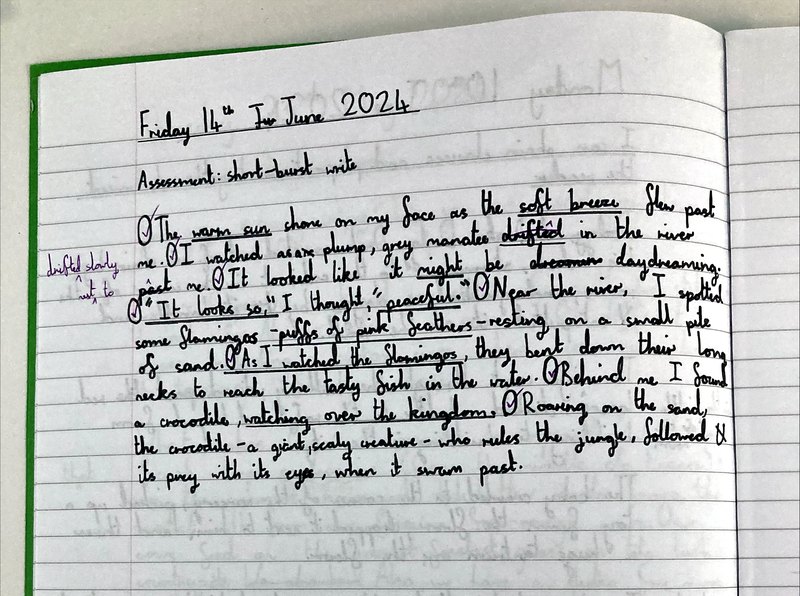
Here's a 9-year-old pupil who began the year with slow, inconsistent letter formation and no awareness of how to join. After a year of focused handwriting teaching, her writing was transformed.
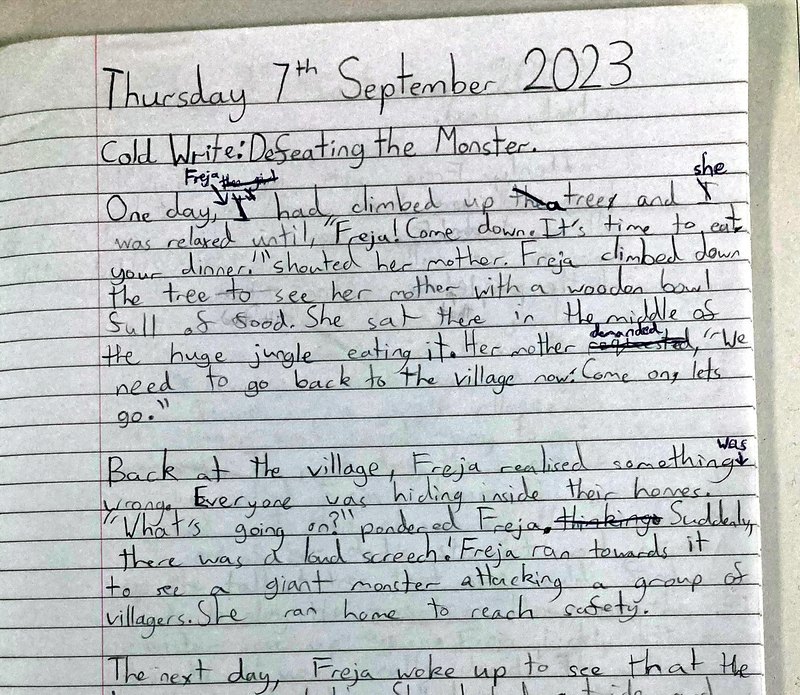
A Year 5 pupil's handwriting across one school year (September 2023 → June 2024), before and after focused handwriting teaching.
Composition is the act of deciding what a piece of writing says — choosing ideas, organising them, and finding the words. I teach it using Talk4Writing, where children learn to say a sentence aloud, developing an ear for how a good sentence sounds, before they ever write it down.
That starts with a model text. I write it myself, built around the sentence structures and genre conventions I want a child to learn: a story, a report or a set of instructions, fiction or non-fiction. The child learns it off by heart, saying it aloud until it's fluent, and in doing so absorbs its structures and conventions until they start appearing naturally in their own writing.
Saying it first does work a blank page can't: it lets a child rehearse rhythm and structure out loud, correct it by ear, then transfer a sentence they already know is good onto the page.
As Writing Lead, I wrote every year group's model texts, from Year 1 to Year 6. That's years of experience building texts that develop a child's compositional skill, and knowing exactly how to tailor one to any year group or ability.
Talk4Writing only takes a child so far. It starts them off, giving them a feel for how a good sentence sounds. But to become truly competent writers, children must understand grammar itself: the rules that let them build and manipulate a sentence deliberately, rather than just reusing a sentence structure they've heard.
I teach this using Rainbow Grammar, a colour-coding system where the key components of a sentence get their own colour.
A child learns where they can place a clause or phrase within a sentence to change how it reads: from plain and functional to varied and sophisticated.
The same sentence, with one new piece of grammar added at a time, building to a sentence combining five different structures at once.
Here's what it looks like in a real child's writing. This particular pupil came from a low-income family, in a cohort whose learning had already been disrupted by Covid, teacher absence and poor behaviour from other pupils. She started the year writing at the level expected for her age — and finished it writing at a level only the strongest few writers reach nationally.
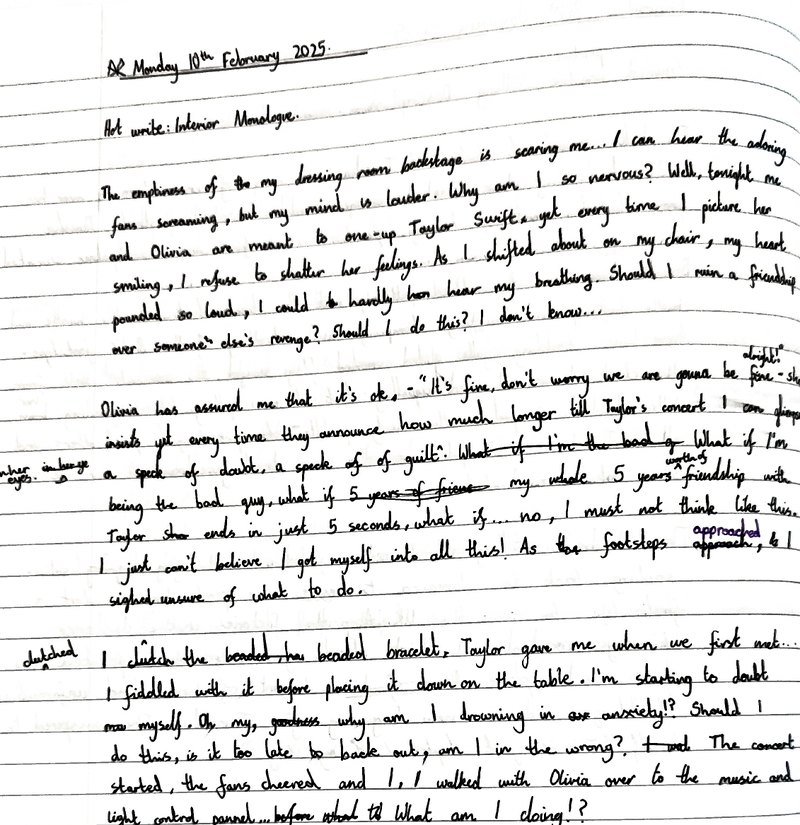
An excerpt of her writing by the end of the year — complex sentences, varied structures, and figurative language, all built on the foundations above.
If writing is where your child needs support, I'd be glad to talk through what's holding them back.
Arrange a consultationI have a proven track record of turning hesitant young mathematicians into confident, flexible problem-solvers.
Getting there means developing three key areas: number sense, arithmetical fluency, and reasoning and problem-solving. Here's how I teach them.
Number sense is a child's feel for what a number actually represents, rather than just the ability to recall a fact or follow a set of steps. A child with strong number sense can estimate sensibly, notice when an answer looks wrong, and choose whichever method suits the problem in front of them, instead of working through the same procedure every time.
I build this using Concrete, Pictorial, Abstract (CPA), a method central to the Singapore Maths approach: a new idea is introduced with real objects, then with a drawn or pictorial version of the same idea, and only written as numbers and symbols once both of those are secure. If a child is learning to add 3 and 4, they might start by counting out three counters and four counters and pushing them together, then draw three dots and four dots instead, and only once that feels natural move to writing "3 + 4 = 7."
I never let a child skip to the numbers just because they've guessed the right answer, because without real understanding, the gap resurfaces and causes problems later.
The same idea, three ways: a child only moves to the next stage once the one before it is secure.
Number sense gives a child understanding, but without fluency, that understanding stays slow and effortful. Fluency frees up working memory, so instead of struggling over a basic calculation, a child has the headspace to grapple with what's actually in front of them. Skip it, and they never get the chance to practise harder problems, so their mathematical knowledge stalls.
In practice, fluency comes down to a handful of single-digit facts: number bonds, addition and subtraction within 10, times tables, and the division facts hidden inside them. With solid place value from their number sense, a child needs little else, since working with bigger numbers is just a matter of knowing where the digits sit. Real fluency is about more than speed: it's being able to move between different methods and pick whichever one suits the problem best. Once number sense and fluency are in lockstep, calculation stops being a barrier, and a child is free to take on the deeper, more conceptual side of maths.
I use practice tools I've built myself that promote both rote learning and varied fluency practice, mixing up how I present the same idea so a child understands it from every angle. For example, I might teach the same multiplication fact as repeated addition, as an array of objects, as a division, and as a quick mental strategy, as well as by rote. The results speak for themselves: my last class averaged 24.1 out of 25 in the Multiplication Tables Check, the UK's national times-tables test for 8–9 year-olds, against a national average of 21.0.
Average score (out of 25) in the UK's national Multiplication Tables Check.
Number sense and fluency give a child the tools; reasoning is what teaches them to use those tools well. It means noticing patterns, explaining why something works, trying out ideas, and generalising from one problem to the next, not just landing on the right answer. I build this in from the very start, not as a bonus skill saved for after the method's been taught.
I teach it by modelling the process myself: solving a problem out loud, step by step, so a child can see exactly how an expert thinks it through, not just the finished answer. This is sometimes called worked-example teaching, drawn from research by the educational psychologist Barak Rosenshine. Once they've seen that thinking made visible, I give them plenty of similar problems to practise the same techniques on themselves.
Success StoriesA refugee pupil arrived in my class below the expected standard in maths, missing the foundation in number sense and fluency that reasoning depends on. Once that foundation was in place, a real strength emerged: they took to problem-solving quickly, especially once they'd seen a worked example to model the process. By the end of the year, they were working at greater depth.
Another pupil arrived with severe maths anxiety, finding timed conditions and problem-solving overwhelming. I met with her parents and put together an individual support plan: she learned to recognise when anxiety was building and what was triggering it, and we practised breathing techniques to help her calm down in the moment. Alongside that, we spent the year building her number sense and fluency, giving her the confidence to finally tackle the reasoning that had been causing her anxiety. By the end of the year, she'd moved from just below the expected level to meeting it, and scored full marks in her times-tables test.
Her parents are delighted with the progress she's made:
"Her confidence has turned around completely, she goes into tests calm instead of panicking, and genuinely enjoys maths now."
Eight years teaching in state primary classrooms, with pupils across the full range of ability and need, gives me the confidence that I can develop any child's mathematical ability with real expertise.
If maths is where your child needs support, I'd be glad to talk through what's holding them back.
Arrange a consultationIf you'd like to talk through how this applies to your child specifically, I'd be glad to walk you through it.
Arrange a consultation